
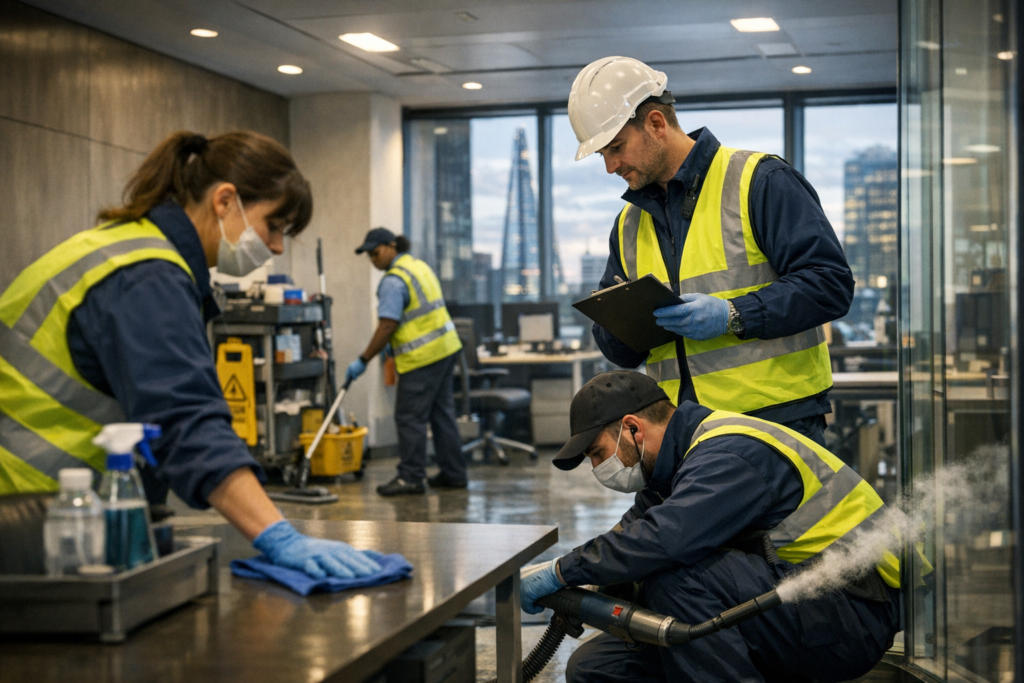
Commercial cleaning London is a critical service for maintaining workplace hygiene, ensuring compliance, and supporting operational efficiency across diverse commercial sectors. For UK businesses, property managers, and facilities teams, understanding what to expect from professional cleaning services in London is essential to achieving consistent quality, regulatory adherence, and cost-effective outcomes.
Overview of Commercial Cleaning Services in London
Commercial cleaning encapsulates a broad range of services tailored to the needs of business environments. This includes routine office cleaning London providers deliver, deep cleaning services for industrial settings, and specialised janitorial services UK-wide. These services are integral to maintaining a safe, hygienic, and compliant workplace, directly impacting employee wellbeing, customer perceptions, and operational continuity.
Defining Commercial Cleaning
Commercial cleaning refers to the professional cleaning of non-residential buildings such as offices, retail outlets, healthcare facilities, warehouses, and industrial premises. Unlike domestic cleaning, commercial cleaning involves adherence to industry-specific standards and regulations, often requiring tailored workflows and certified staff to address the unique challenges of high-traffic or heavily regulated environments.
Relevance to UK Business Operations
For organisations operating in London, commercial cleaning services play a vital role in:
- Supporting compliance with health and safety legislation
- Maintaining high standards of workplace hygiene London demands
- Reducing the risk of workplace illness and contamination
- Enhancing the aesthetic and functional quality of commercial premises
- Ensuring alignment with corporate social responsibility (CSR) and environmental policies
UK Industry & Compliance Landscape for Commercial Cleaning
Operating commercial cleaning services in London requires strict adherence to multiple regulatory frameworks. Compliance is not only a legal obligation but also a risk management imperative for businesses.
Key Regulatory Requirements
- Health & Safety at Work Act 1974: Places a duty on employers to ensure the health, safety, and welfare of employees and visitors. Cleaning services must be conducted safely, minimising hazards.
- COSHH Regulations (Control of Substances Hazardous to Health): Governs the handling and use of cleaning chemicals. Cleaning companies must ensure safe use, storage, and disposal.
- Workplace (Health, Safety & Welfare) Regulations 1992: Cover cleanliness, ventilation, and sanitary conveniences, stipulating minimum hygiene standards.
- British Institute of Cleaning Science (BICSc) Standards: Industry-recognised benchmarks for professional cleaning services, promoting best practices and quality assurance.
- Environmental Compliance: Including Duty of Care under Waste Regulations 2011 and the Environmental Protection Act 1990, which regulate waste handling and disposal.
- Contract Cleaning London Operators: Often need to demonstrate compliance through certifications such as ISO 9001 (Quality Management) and ISO 14001 (Environmental Management).
Operational Challenges for UK Businesses
- Managing the complexity of compliance across multiple regulatory domains.
- Coordinating cleaning schedules that minimise disruption to business operations.
- Ensuring consistent quality and hygiene standards across diverse locations.
- Balancing cost control with the need for specialist cleaning expertise, especially in sectors like healthcare or industrial environments.
Core Aspects of Commercial Cleaning Services
Benefits of Professional Commercial Cleaning
- Enhanced Workplace Hygiene: Reduces microbial contamination, allergens, and pollutants, contributing to healthier environments.
- Regulatory Compliance: Ensures adherence to health and safety and environmental standards, reducing legal risks.
- Improved Employee Productivity: Clean workplaces correlate with higher morale and reduced absenteeism.
- Positive Customer Impressions: Clean premises reflect professionalism and care.
- Cost Efficiency: Preventative cleaning reduces the need for reactive maintenance and damage repair.
Use Cases by Industry
| Industry | Cleaning Needs | Typical Services |
|---|---|---|
| Retail | High footfall, frequent surface cleaning | Daily office cleaning London, floor care, window cleaning |
| Construction | Post-construction deep cleaning | Deep cleaning services, debris removal, industrial cleaning UK |
| Corporate | Office hygiene, meeting rooms | Janitorial services UK, contract cleaning London, sanitisation |
| Healthcare | Infection control, stringent hygiene | Specialist cleaning, COSHH-compliant chemical use, waste disposal |
| Industrial | Heavy-duty cleaning, equipment maintenance | Industrial cleaning UK, hazardous waste management |
Operational Workflows
Effective commercial cleaning involves:
- Assessment & Planning: Site audits to determine cleaning scope and frequency.
- Scheduling: Aligning cleaning times to business operations to minimise disruption.
- Execution: Deployment of trained staff using appropriate tools and chemicals.
- Quality Control: Routine inspections and compliance checks to maintain standards.
- Reporting: Documentation for transparency and continuous improvement.
Challenges & Mitigation Strategies
| Challenge | Mitigation Strategy |
|---|---|
| Chemical safety compliance | Staff COSHH training; use of eco-friendly products |
| Disruption to business operations | Flexible scheduling; after-hours cleaning |
| Maintaining consistent standards | Regular audits; BICSc accreditation |
| Waste disposal and environmental impact | Duty of Care compliance; recycling policies |
Importance of Commercial Cleaning Services for UK Businesses
Risk Reduction
Professional cleaning reduces risks related to slips, trips, infections, and contamination, which are common workplace hazards. Maintaining compliance with COSHH and health and safety regulations mitigates potential legal liabilities.
Compliance Assurance
Contract cleaning London providers offer documented evidence of compliance, supporting business audits and inspections. This is crucial for sectors under rigorous regulatory scrutiny such as healthcare and food production.
Operational Continuity
A clean and hygienic environment supports uninterrupted business activities by reducing employee illness and equipment downtime due to contamination.
Cost Efficiency
Investing in professional cleaning prevents expensive damage to property and equipment, extends asset life, and lowers insurance premiums related to health and safety claims.
How to Choose the Right Commercial Cleaning Service Provider
Key Evaluation Criteria
- Certifications and Accreditations: Look for BICSc membership, ISO certifications, and compliance with SIA if security-linked services are integrated.
- Experience and Industry Expertise: Providers familiar with your sector’s unique requirements.
- Scalability: Ability to service multiple sites or expand service scope.
- Technology & Reporting: Use of digital checklists, real-time reporting, and environmental monitoring tools.
Operational and Compliance Considerations
- Staff training records and health & safety policies.
- Data protection compliance if services involve access to sensitive areas.
- Environmental responsibility including use of biodegradable products and waste management practices.
Common Misconceptions About Commercial Cleaning
-
Myth: Commercial cleaning is just about aesthetics.
Reality: It is crucial for health, safety, and regulatory compliance, not just appearance. -
Myth: All cleaning companies offer the same service quality.
Reality: Industry certifications and tailored service models significantly affect outcomes. -
Myth: Deep cleaning is only necessary occasionally.
Reality: Regular deep cleaning is essential, especially in healthcare and industrial sectors, to manage contamination risks.
Frequently Asked Questions (FAQs)
Q1: What does commercial cleaning in London typically include?
Commercial cleaning London covers office cleaning, janitorial services, deep cleaning, waste disposal, and specialist cleaning tailored to industry needs, following UK health and safety and environmental regulations.
Q2: Why is professional office cleaning London important for businesses?
It ensures workplace hygiene, supports regulatory compliance, reduces illness-related absenteeism, and enhances overall operational efficiency.
Q3: How do UK regulations affect commercial cleaning services?
Regulations like the Health & Safety at Work Act, COSHH, and Waste Regulations mandate safe chemical use, hygiene standards, and responsible waste management, which cleaning companies must strictly follow.
Q4: What certifications should I look for in a cleaning company UK-wide?
Look for BICSc accreditation, ISO 9001, ISO 14001, and compliance with COSHH and Health & Safety standards to ensure quality and compliance.
Q5: How often should deep cleaning services be conducted?
Frequency depends on industry and usage, but high-risk environments such as healthcare require regular deep cleaning, often weekly or monthly, to maintain hygiene standards.
Q6: Can technology improve commercial cleaning services?
Yes, innovations like AI-driven scheduling, digital reporting, and smart monitoring enhance efficiency, transparency, and compliance.
Q7: What are the environmental responsibilities of commercial cleaning providers?
They must comply with Duty of Care waste regulations, use eco-friendly products, and implement sustainable waste disposal and recycling practices.
Emerging Trends in UK Facilities and Security Industry
Technology Adoption
AI, automation, and IoT-enabled smart monitoring are transforming commercial cleaning, enabling predictive maintenance and data-driven quality control.
Integrated Service Models
Combining cleaning with security and facilities management services optimises operational efficiency and compliance management.
Sustainability and ESG
There is increasing focus on reducing environmental impact through green cleaning products, waste minimisation, and energy-efficient cleaning equipment, aligning with broader UK sustainability goals.
Conclusion
Commercial cleaning London is a multifaceted service vital to maintaining compliance, hygiene, and operational excellence across UK businesses. Understanding regulatory contexts, industry-specific needs, and emerging trends helps facility managers and property owners make informed decisions. By selecting qualified providers with certified processes and embracing technology and sustainability, organisations can ensure risk reduction, regulatory adherence, and enhanced workplace wellbeing without compromising on cost efficiency or operational continuity.
For further insights on integrated facilities management, security services, and property maintenance, reviewing comprehensive service frameworks can provide additional context to optimise your commercial property operations.