
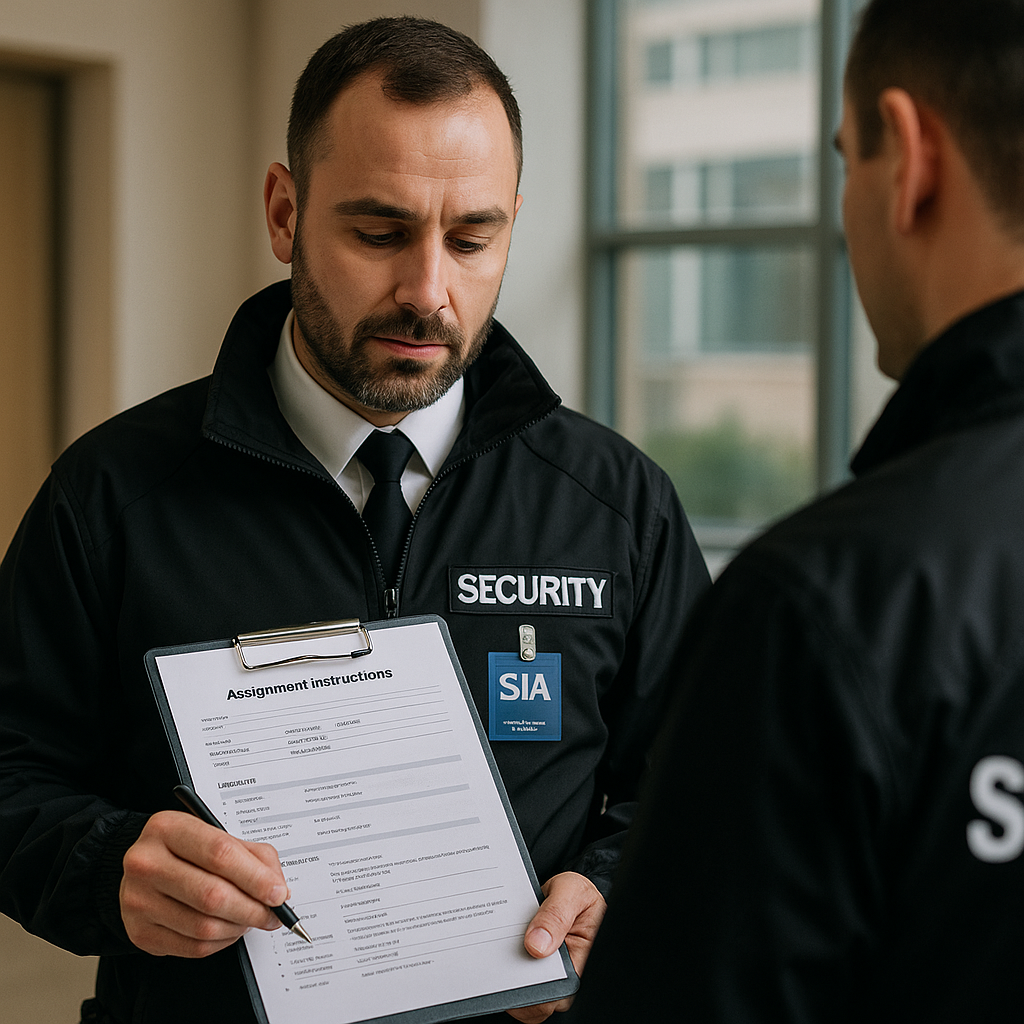
Security guarding fails quietly when security site briefs are vague
The guard arrives at 6:45 am, signs the key log, and gets told, “Just keep an eye on the back gate.” That sounds simple until a delivery van blocks the fire exit, a contractor walks in without a pass, and nobody knows who can approve access after 5 pm.
This is how UK security guarding fails quietly. Not with sirens. Not always with a break-in. Often, it starts with thin security site briefs that leave SIA licensed guards guessing on the small things that matter.
A vague brief looks harmless at 7 am
A weak brief rarely looks dangerous on paper. It may be one page, copied from an older site, with a few phone numbers and a line saying “patrol hourly.” Honestly, that is not enough for a live site with staff, visitors, stock, keys, vehicles, alarms, and out-of-hours calls.
The problem is simple. Manned guarding depends on clear local knowledge. A trained guard can read behaviour, manage access, and write a clean report, but they still need to know what “normal” looks like at that address.
The quiet failure pattern
Most failures start as small judgement calls. A guard lets in a familiar-looking contractor because nobody listed the approved trades. A fire door is found open twice, but the report only says “all in order” because the escalation rule was never explained.
Then the site manager asks, “Why was this missed?” Fair question. But was the guard told what to check, who to call, and what counts as urgent?
Where professional standards meet site detail
Professional security services should not rely on memory or guesswork. A guard may hold an SIA licence, wear the right uniform, and follow company policy, yet still be under-briefed for that site.
Good security is local. The same guard who works well at a retail park may need a different routine at a warehouse in Leeds, a student block in Manchester, or a construction site in Birmingham. Different site, different risk.
What security site briefs should actually cover
A proper site brief is not a long legal file that nobody reads. It is a working document. It should help the guard make the right decision at 2 am when the site manager is asleep and the alarm panel is flashing amber.
The brief should match the site’s real use. A quiet office with 60 staff does not need the same instructions as a food warehouse with chilled loading bays, agency drivers, and £80,000 of stock moving before lunch.
At a minimum, security site briefs should cover:
- Site address, layout, entry points, and restricted zones
- Normal opening hours, shift changes, and expected visitor flow
- Key holding rules, alarm codes, and lock-up routine
- Names and numbers for escalation, including out-of-hours contacts
- Known risks such as trespass, theft, protests, leaks, or anti-social behaviour
- Patrol routes, patrol times, and any no-go areas
- Access rules for staff, visitors, contractors, and delivery drivers
- Reporting format, photo rules, and incident categories
The site risk profile should be blunt
The site risk profile should say what the site is actually worried about. Not vague lines like “protect premises.” Say it straight: copper theft, tailgating at reception, staff parking disputes, fake couriers, rough sleepers in the bin store, or kids climbing scaffolding after school.
This helps the guard look in the right places. It also helps supervisors check performance fairly. If the main risk is fuel theft, patrols around the generator and storage tank should not be treated as optional.
Assignment instructions must be usable
Assignment instructions need to be written for the person standing on post, not for a tender document. Short sentences help. Site maps help even more.
A good instruction says, “Check the east roller shutter at 19:00, 22:00, 01:00, and 04:00. Report any gap, damage, or sign of tampering to the control room within 10 minutes.” That beats “conduct regular external checks” every day of the week.
Why small gaps become real security failures
Security errors often sit hidden until something goes wrong. A missed patrol may not matter on Monday. By Thursday, the same blind spot may be where pallets disappear, a door is wedged open, or a banned visitor comes back.
This is why vague briefs are expensive. The cost is not only theft. It can be lost time, angry tenants, damaged trust, insurance questions, or a painful meeting with the client’s regional manager.
Access control gets messy fast
Access rules need sharp edges. If the brief says “allow authorised persons only” but does not name the system, the guard is left to judge faces, hi-vis jackets, and confidence.
That is risky. Some people sound very convincing at a gatehouse window. A decent brief should explain:
- Which ID is accepted
- Who can approve visitors
- What to do if the visitor is not on the list
- Whether photos are allowed on site
- Which areas need escorting
- How to deal with refused entry
Patrols lose their value
A patrol is not a walk for the sake of ticking a scanner point. It should match the site risk. If the risk sits at the back fence and the patrol route stays near reception, the guarding is busy but not useful.
Small details matter here. Lighting levels, broken CCTV views, blind corners, loose panels, and doors that swell in wet weather should all feed into the route. Rainy nights expose weak briefs very quickly.
Incident reporting becomes too thin
Poor incident reporting is another quiet failure. A line like “youths seen near gate” tells the next shift almost nothing. How many? What time? Which gate? Did they leave when challenged? Was CCTV tagged?
Clear reports protect the guard and the client. They also help spot repeat issues, like the same silver van stopping near the loading bay every Friday at 18:20.
How assignment instructions turn into daily action
Good instructions do not sit in a folder at reception. They shape every shift. The guard reads them, the supervisor checks against them, and the client updates them when the site changes.
There is a simple flow that works well for manned guarding sites:
- Walk the site with the client before the first shift.
- List the real risks, not just the obvious doors and gates.
- Write draft assignment instructions in plain English.
- Test them during a live shift or night visit.
- Fix unclear lines before they become habits.
- Review after incidents, layout changes, or new working hours.
That may sound basic. Still, many sites skip step four. The document gets approved in an office, then fails at the gate because nobody checked if the guard can see the delivery lane from the hut.
Supervisors need to check the brief, not only the guard
A supervisor visit should ask more than, “Are you okay?” It should test whether the brief works. Can the guard find emergency contacts quickly? Do they know the escalation point for a water leak? Can they explain the access rule for agency workers?
This is not about catching people out. It is about finding weak instructions before a real incident exposes them. I would rather fix a bad paragraph on Tuesday than defend a missed alarm on Saturday.
Updates should not wait for contract review
Sites change quietly. A new tenant moves in. The rear car park becomes staff-only. A temporary gate stays for six months. The security brief must keep up.
A short change log helps. Date the update, note what changed, and tell every guard on the rota. For UK security guarding, that one habit saves a lot of confusion across day, night, and relief shifts.
Common brief mistakes on UK guarding sites
The same mistakes show up across offices, warehouses, residential blocks, retail parks, and building sites. They are not always dramatic. That is exactly why they last so long.
One common issue is copying old text from a previous contract. The site name changes, but the duty pattern, contact list, and patrol points remain half-wrong. Nobody notices until the guard calls a number that was disconnected two years ago.
Watch for these brief problems:
- Old emergency contacts with no second option
- Patrol times that clash with gate duties
- No clear rule for refused access
- Alarm instructions written for a different panel model
- Missing key register process
- No guidance for lone working checks
- Reports that ask for detail but give no format
- No mention of tenant-specific rules
“Use common sense” is not an instruction
Common sense helps, but it is not a procedure. One guard may challenge every unknown visitor. Another may avoid conflict unless the brief clearly backs them.
SIA licensed guards should not be left to invent local rules under pressure. If the client wants strict access control, say so. If the site prefers a softer reception style during office hours, say that too.
Too much text can also fail
A 60-page brief is not always better. If the guard cannot find the emergency shut-off point, the document is too heavy. The best briefs are clear, layered, and easy to search.
Use a short quick-reference sheet for urgent actions. Keep the detailed version nearby for full procedures. Simple wins at 3 am.
Better briefing for manned guarding teams
A strong brief is built with the guard’s shift in mind. Start with the moments where things can go wrong: opening, lock-up, deliveries, visitor peaks, alarm calls, staff leaving late, and weekend quiet hours.
Good professional security services usually treat the brief as a live tool. It should be reviewed by operations, the client, and the front-line guard. The person doing the patrol often spots the missing detail first.
What to include on the first page
The first page should answer urgent questions fast. Nobody wants to search through policy wording while a contractor is arguing at the barrier.
Useful first-page items include:
- Emergency services guidance and exact site access point
- Control room number and client escalation order
- Fire panel location and assembly point
- Alarm response steps
- High-risk areas for each shift
- Current temporary hazards or works
- Basic access rules in plain words
How to keep briefs alive
Review the brief after every meaningful incident. Not every small note needs a rewrite, but repeated issues should change the instructions. If three reports mention tailgating, the brief should say how to challenge it and where it happens most.
A monthly check is enough for stable sites. High-risk sites may need weekly tweaks, especially construction projects where fencing, access roads, and site cabins move often.
Frequently Asked Questions
What are security site briefs?
Security site briefs are written instructions that tell guards how a specific site should be protected. They usually cover access control, patrols, risks, reporting, emergency contacts, and escalation steps. A good brief turns general guarding skill into site-specific action.
Why do vague assignment instructions cause guarding failures?
Vague assignment instructions leave guards to guess what the client expects. This can lead to missed patrol points, weak access control, poor reports, and slow escalation. The risk is higher during nights, weekends, and relief shifts.
How should a site risk profile be written?
A site risk profile should name the real threats at that location. For example, it should state “fuel theft from generator compound” rather than “general theft risk.” It should also link each risk to a patrol, check, or reporting action.
What should SIA licensed guards receive before starting on a new site?
SIA licensed guards should receive clear site instructions before their first shift. The handover should include:
- A walk-around of key areas and access points.
- Emergency contacts and escalation rules.
- Patrol routes and reporting method.
- Current risks, temporary works, and known problem areas.
How often should security site briefs be reviewed?
Security site briefs should be reviewed after any incident, site layout change, tenant change, or shift pattern change. Stable sites can review them monthly or quarterly. Fast-moving sites, such as construction projects, may need weekly updates.
What is the difference between manned guarding and mobile patrol instructions?
Manned guarding instructions are written for guards based on site for a full shift or set duty period. Mobile patrol instructions are usually shorter and focus on timed visits, lock checks, alarm response, and visible checks. Both need clear reporting and escalation rules.
Briefs fail quietly, so fix them early
Security site briefs are not paperwork for the sake of paperwork. They are the guard’s map, memory aid, and back-up when the site gets awkward.
If the brief is vague, even good UK security guarding can drift into guesswork. Clear instructions will not solve every problem, but they give guards a fair chance to protect the site properly.